
How (and why) I’m helping everyone learn more about menopause
Linsey Lee, a Support Worker in the Adult Social Care Mental Health Team at Blackpool Council, shared a lovely story with us recently – and it’s a brilliant example of how one simple act can make such a difference. She’s now on a mission to help men and women in the workplace learn more about menopause…

A scary first menopause symptom
My menopause story started a couple of years ago, when I was a Civil Enforcement Officer – or, in plain English, a traffic warden.
The first symptom I experienced was quite scary, to be honest. I was 46 and started having heart palpitations. I had no idea what was going on.
I went to the doctor, who carried out ECGs but found nothing wrong. Unfortunately, I wasn’t given any explanation as to the potential cause.
The palpitations eventually stopped, but then one day there was a knock at the front door. Suddenly, my heart started pounding, my stomach flipped, I became sweaty, and I felt sheer panic. There was no reason for it, and it had never happened before. It was only the Amazon delivery driver, who called most days anyway, but that didn’t cross my mind at the time.
This was the start of losing all my self-confidence. And that was a real problem. Because I was a traffic warden, remember, working alone and dealing with confrontation on a daily basis. It began to affect my work.
Eventually, I spoke to my manager, who at the time was a man. Thankfully, he had completed menopause awareness training and completely understood where I was coming from. He advised me to visit the doctor again.
I thought that was great until he said: “You are confrontation; it’s what you do.” I replied: “I was, and it’s what I did.”
HRT issues added to the frustration
I went back to the doctor and was prescribed HRT, along with a medication called Propranolol to help with the anxiety. It was then that I started to understand the brain fog and recognise the impact menopause was having on me. My husband had seen me cry more in those few months than he had in the previous 25 years and, understandably, it caused him concern too.
I started my HRT treatment using patches. They helped with the tearfulness, but not much else. Because I was still sweating so much, the patches kept falling off, which only added to the frustration I was already feeling on certain days. I then switched to a gel, but unfortunately that didn’t suit me either.
In the end, I decided to stop HRT and try herbal remedies instead. The main one I used was the Nutrition Geeks Menopause Bundle, alongside seaweed and beetroot capsules. I now find that my symptoms are nowhere near as bad as they were before.
Helping everyone to learn more about menopause
My own experience led me to want to help other people – especially those who feel like they can no longer do a job they have always done well. One of my biggest passions is encouraging men in the workplace to learn more about menopause. I’m pleased to say that since I recently became a Menopause Champion, a male social worker in my team has attended a menopause awareness course (and I’m hoping to help him start a trend in that regard).
I also completed the Making Menopause Work course and learned so much, not only for myself but for others too.
There is nothing worse than feeling confused and alone because you no longer recognise yourself. If I can help just one person feel understood, supported and less isolated, then I will feel that I have achieved something worthwhile.
Creating micro ripples of change
While attending the Making Menopause Work training, I was inspired by the idea of creating micro ripples of change. It got me thinking about what small action I could take in my own workplace.
I work in a large office shared by NHS and Council Mental Health teams. After some thought, I decided to put the word Menopause on my locker.
It felt like a simple start, but then I realised it needed something more. So I printed a few quotes and positive messages to display alongside it.
A little later, while enjoying one of my favourite pastimes (browsing the SHEIN app), I came across some motivational stickers. The only catch was that they came in packs of 100! Never mind, I thought, they’ll do.
Sparking conversations, spreading positivity
I selected a few stickers to decorate my locker and then placed the remaining stickers on an open desk in the office for anyone to take. Before I knew it, my micro ripple had turned into a tidal wave!
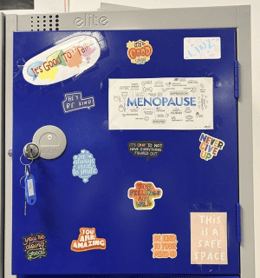
Colleagues started adding the stickers to their laptops, lunch bags, notebooks and workspaces. Soon, people were asking each other, “Where did you get that from?” The reply was often: “Linsey left them on the desk.” This curiosity led more and more people to visit the locker and engage with the messages displayed there.
The feedback has been overwhelmingly positive. What started as a small idea inspired by menopause awareness training has helped spark conversations, spread positivity and make our office a brighter, more colourful place.
It has shown me that even the smallest action can create a much bigger impact than we ever expect.