
Why Does Menopause Feel Harder Than It Did for Our Mothers?
By Simona Stokes – Counselling Psychologist, Accredited CBT Therapist, Certified Lifestyle Medicine Professional
One of the comments I hear most often from women is this:
“My mum went through menopause without HRT or therapy. Why am I struggling so much?”
It’s usually followed by another thought that isn’t spoken quite so openly:
“Maybe I should just cope better.”
I don’t think that’s the right conclusion.
In fact, I think we’re asking the wrong question.
Our mothers and grandmothers experienced the same biological transition. The hormonal changes of menopause haven’t suddenly become more difficult.
What has changed is the world in which those hormonal changes occur.
Today’s women are often juggling careers, caring for children and ageing parents, managing relationships, worrying about finances and working for longer before retirement. We live in a culture that expects us to stay productive, energetic and youthful, while remaining constantly available through emails, smartphones and social media.
Our physical environment has changed too. Air pollution, ultra-processed foods, endocrine-disrupting chemicals, increasingly sedentary lifestyles and chronic stress all place additional demands on the body. None of these causes menopause, but they all contribute to the overall load our brain and body are carrying.
When you put all of that together, it’s perhaps not surprising that many women feel overwhelmed during midlife.
Menopause doesn’t happen in isolation
One of the biggest misconceptions about menopause is that it’s only about hormones. Hormones are undoubtedly important, but they are only one piece of the puzzle.
How we experience menopause is also influenced by our sleep, stress levels, physical health, nutrition, movement, relationships, work demands, emotional wellbeing and the environment we live in.
I often encourage women to think of this as their overall load.
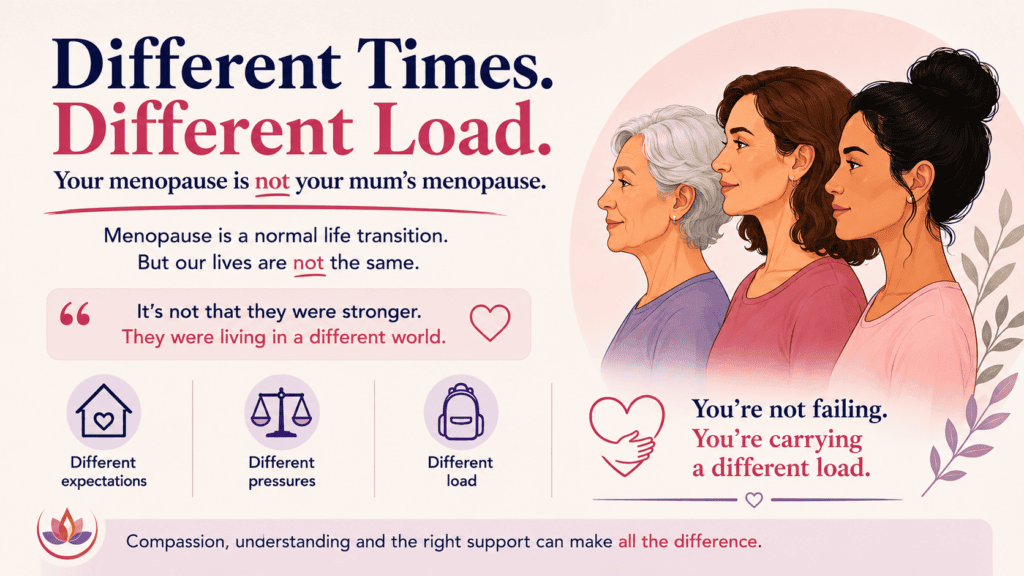
Imagine carrying a backpack. The hormonal changes of menopause add weight. But so do years of poor sleep, caring responsibilities, work pressures, financial worries, chronic stress, health conditions and the countless demands of everyday life. Eventually, it isn’t one thing that becomes overwhelming. It’s the combined weight of everything we’re carrying.
This helps explain why two women with very similar hormonal changes can have very different experiences.
Asking a different question
Instead of asking, “Why can’t I cope?”, try asking, “What is adding to my load?”
For one woman, it might be months of disrupted sleep. For another, it may be the emotional strain of caring for elderly parents while supporting teenage children. For someone else, it could be workplace stress, relationship difficulties or a long-term health condition.
Often, there isn’t one single cause. It’s the accumulation of many small pressures over time.
When we begin to recognise what’s contributing to that load, we can also start thinking about what might lighten it.
What can help?
Every woman’s situation is different, but there are a few questions worth considering:
- Am I getting enough good quality sleep?
- What is creating the greatest stress in my life right now?
- Have I been putting everyone else’s needs before my own?
- What helps me recharge, and have I stopped making time for it?
- Is there something I could ask for help with instead of carrying it alone?
- Would it be helpful to speak to my GP or another healthcare professional about my symptoms?
We don’t need to create a perfect lifestyle or eliminate every source of stress. That’s neither realistic nor necessary.
Instead, small, consistent changes often make the biggest difference. Improving sleep, moving your body regularly, nourishing yourself well, setting healthier boundaries or simply allowing yourself to rest can all help increase your capacity to cope.
A little more compassion
If you’ve been comparing yourself to your mother or grandmother, perhaps it’s worth remembering this: It’s not that they were stronger. They were living in a different environment.
The biology of menopause may be similar, but the lives women lead today are not. We are faced with different expectations, different pressures, different load.
So perhaps the question should not be “Why am I struggling?” but perhaps should be: “Given everything I’m carrying, what do I need right now?”
Sometimes, that small shift in perspective is the first step towards treating ourselves with the compassion we so readily offer everyone else.
About the author

Simona Stokes is a Counselling Psychologist, Accredited CBT Therapist, Certified Lifestyle Medicine Professional and founder of the Menopause CBT Clinic®. She works clinically with women experiencing the psychological impact of perimenopause and menopause while also training mental health professionals internationally in Menopause-Informed Psychological Care. She is the creator of the EMBERS® CBT framework, which integrates menopause science with evidence-informed psychological practice.